
In today’s digital economy, customer expectations are evolving at lightning speed. They want answers now, on any channel, personalized to their needs, and delivered with empathy and efficiency. But for many businesses, outdated support tools stand in the way of delivering that kind of experience.
The truth is blunt: relying on legacy systems and manual workflows isn't just slowing down your team—it’s costing you customers, credibility, and competitive advantage.
Fortunately, there’s a solution that’s revolutionizing service delivery across industries: AI customer service. By combining intelligent automation, real-time data access, and conversational understanding, AI is enabling businesses to leapfrog the limitations of traditional tools and transform their support operations from a cost center into a growth engine.
In this deep dive, we’ll explore:
How outdated tools are quietly eroding your business performance
Why AI customer service is a game-changing solution
Real-world examples of AI-powered support
A roadmap to modernizing your support stack with AI
I. The Problem with Outdated Support Tools
Many businesses fail to realize how much their current support infrastructure is holding them back. Let’s break down the key issues:
1. Slow Response Times
Legacy ticketing systems and siloed communication tools make it hard for agents to access the right information quickly. The result? Long hold times, delayed responses, and frustrated customers.
2. Disconnected Systems
Support teams often work with multiple platforms—CRM, help desk, live chat, phone systems—that don’t talk to each other. Agents spend time toggling between tabs and manually syncing data.
3. No Context, No Personalization
Without intelligent integrations, agents don’t have visibility into the customer’s journey. They ask for the same details repeatedly, deliver generic answers, and miss upsell opportunities.
4. High Operational Costs
Older tools aren’t built to scale efficiently. As ticket volumes grow, companies must hire more agents to keep up—leading to ballooning support costs without improving service quality.
5. Poor Analytics and Insights
Most legacy systems provide limited reporting. This makes it difficult to understand what’s working, spot patterns, or optimize workflows.
6. Agent Burnout
When agents are burdened with repetitive tasks, clunky systems, and irate customers, morale drops. This leads to turnover, increased hiring costs, and lost institutional knowledge.
These issues compound over time. You may be investing in training, quality control, or customer retention strategies, but if your support tech is outdated, you’re pouring water into a leaky bucket.
II. Enter AI Customer Service: The New Standard
AI customer service is not just a trend—it’s a powerful, proven solution that’s transforming how support teams operate.
Unlike traditional tools, AI customer service platforms are designed for real-time, personalized, scalable, and intelligent support. They handle routine inquiries, empower agents, and use data to predict needs and improve outcomes.
Let’s look at what AI customer service makes possible:
III. What AI Customer Service Can Do (That Legacy Tools Can’t)
1. Handle High Volumes Instantly with AI Chatbots
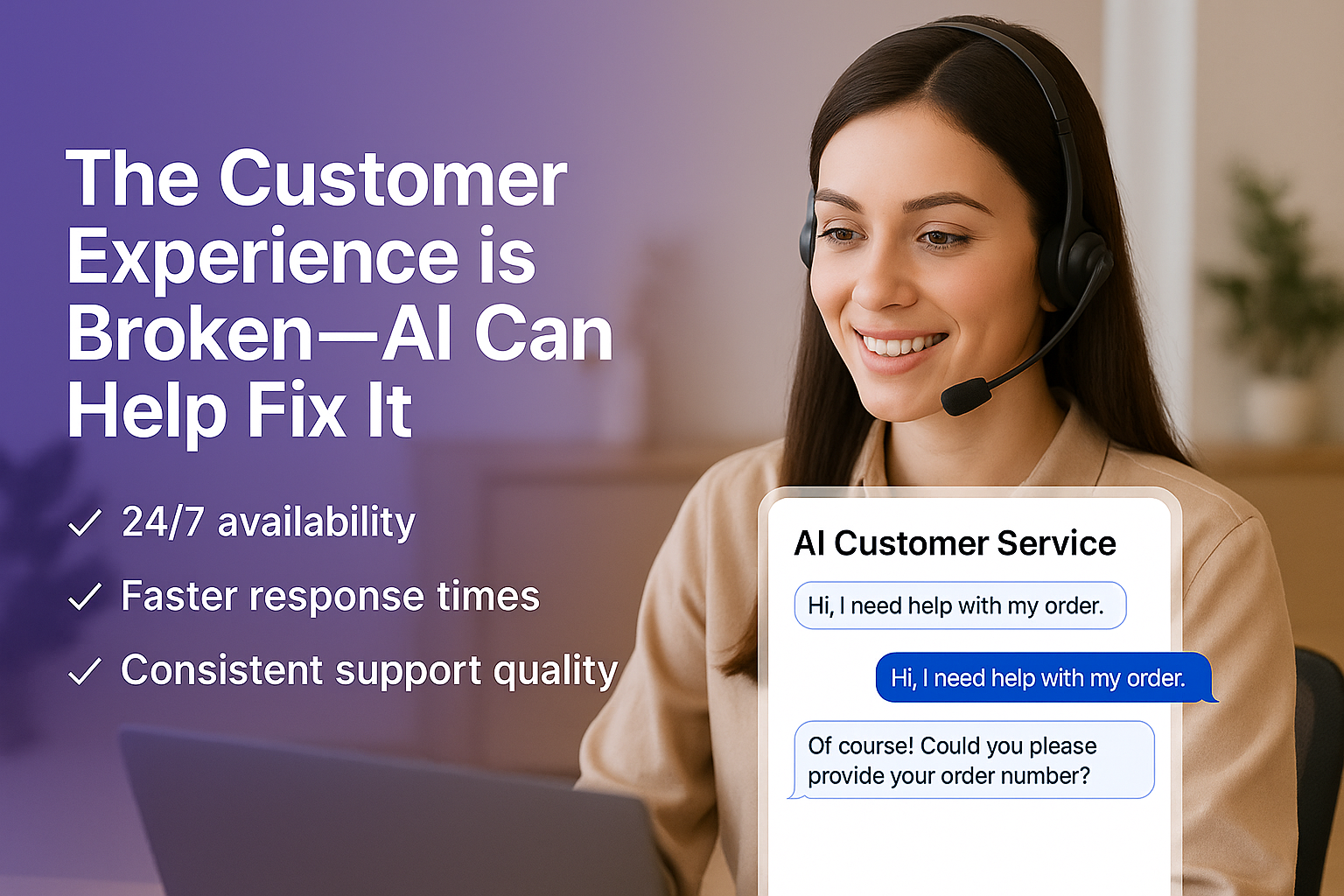
AI-powered chatbots can manage thousands of simultaneous conversations without human intervention. They provide 24/7 availability, answering questions, tracking orders, troubleshooting issues, and routing tickets intelligently.
Example:
An e-commerce brand implements an AI chatbot to handle FAQs and delivery inquiries. It deflects 65% of tickets, reducing agent load and improving response times dramatically.
2. Deliver Personalized Experiences at Scale
AI customer service platforms pull data from CRMs, past interactions, and behavioral signals to deliver tailored responses.
Example:
A returning customer asks about a previous order. The AI assistant references their purchase history, shipping details, and preferences—all within seconds.
3. Assist Human Agents with Real-Time Intelligence
AI doesn’t just help customers directly—it supports agents with contextual information, suggested replies, and relevant knowledge base articles.
Example:
An agent receives a complex issue. AI summarizes the customer’s last three interactions and suggests a resolution, reducing handling time by 40%.
4. Automate Repetitive Workflows
AI customer service can automate tasks like ticket categorization, routing, follow-ups, and status updates.
Example:
An IT support desk uses AI to tag, prioritize, and escalate tickets based on keywords and sentiment, streamlining workload and improving accuracy.
5. Predict and Prevent Problems Proactively
By analyzing usage patterns, feedback, and historical data, AI can predict issues before they arise and trigger proactive outreach.
Example:
A SaaS platform notices users struggling with a new feature. AI automatically offers tooltips, guides, or escalates a live chat before the user submits a complaint.
6. Understand Customer Sentiment
AI tools analyze tone, language, and context to detect frustration or confusion. They prioritize urgent cases and escalate sensitive ones.
Example:
A healthcare provider uses sentiment analysis to fast-track support for anxious or upset patients, improving care outcomes.
IV. Business Impact: Why AI Customer Service Is Worth the Investment
Let’s put numbers to the benefits:
✅ Cost Savings
Automating 60–80% of Tier 1 support inquiries can reduce support costs by 30–50%.
AI scales instantly without proportional headcount increases.
✅ Faster Resolution
AI slashes first-response and resolution times, improving CSAT and retention.
✅ Improved Customer Satisfaction
Personalized, consistent, and instant service boosts NPS and loyalty.
✅ Higher Agent Productivity
AI takes care of repetitive work so agents can focus on complex, high-value tasks.
✅ Better Decision-Making
AI provides actionable insights from customer interactions to improve products, marketing, and support strategies.
V. Real-World Case Studies
🛍 Retail Brand
Challenge: High ticket volume during seasonal sales
Solution: Deployed AI chatbot + agent assist
Results: 70% ticket deflection, 20% rise in CSAT, $1M saved in seasonal staffing
🧑⚕️ Healthcare Provider
Challenge: Long wait times for appointment queries and prescription issues
Solution: AI triage assistant + proactive outreach
Results: 40% reduction in call center load, improved patient experience
🖥 B2B SaaS Platform
Challenge: High churn due to poor onboarding support
Solution: AI-powered onboarding concierge + agent summarization tools
Results: 25% increase in onboarding completion, 15% reduction in churn
VI. Transitioning from Outdated Tools to AI: A Roadmap
If you're ready to replace your outdated systems with AI customer service, here’s how to do it:
Step 1: Audit Your Current Tools
Identify gaps, slow points, and repetitive queries. What’s causing friction?
Step 2: Choose the Right AI Platform
Look for tools that integrate with your existing tech stack (CRM, help desk, live chat) and support multi-channel engagement.
Step 3: Start Small, Think Big
Begin with one use case—like FAQs or order tracking. Gradually scale to more complex workflows.
Step 4: Train Your AI with Real Data
The more data it ingests, the smarter it becomes. Use historical tickets, chat logs, and customer feedback.
Step 5: Monitor, Measure, Improve
Track KPIs like ticket deflection, resolution time, CSAT, and agent productivity. Optimize continuously.
VII. Common Misconceptions About AI Customer Service
❌ “It’s too impersonal.”
Reality: When trained well, AI delivers friendly, contextual, and human-like experiences.
❌ “It’ll replace my team.”
Reality: AI supports your agents—it doesn’t replace them. It reduces their burden and increases their impact.
❌ “It’s too technical.”
Reality: Today’s AI tools are built with low-code/no-code interfaces. Setup is easier than ever.
❌ “It’s only for big companies.”
Reality: SMBs are increasingly adopting AI customer service thanks to affordable pricing and plug-and-play integrations.
VIII. The Future of Support Is Human + AI
The best support experiences combine AI efficiency with human empathy. In this model:
AI handles the predictable
Humans handle the emotional and complex
Both collaborate for better outcomes
In the near future, AI will not just answer questions—it will understand tone, adapt in real time, and continuously improve based on feedback. Early adopters will lead the charge.
Conclusion: Don’t Let Legacy Tools Hold You Back
Every day you stick with outdated support tools, you lose:
Customer satisfaction
Operational efficiency
Revenue and retention
But the cost of doing nothing is avoidable.
AI customer service offers a smarter, scalable, and more sustainable solution. It empowers your team, delights your customers, and positions your business for long-term success.
If you’re serious about improving support, boosting ROI, and staying competitive—AI isn’t optional anymore. It’s essential.
Ready to future-proof your support? It starts with AI.



Write a comment ...